A clearer view of space
An interactive 3D map of the solar system, powered by live data from NASA, JPL, ESA, and more. Click any planet, moon, or spacecraft to fly to it and see where it is right now. Free, in your browser, no sign-up.





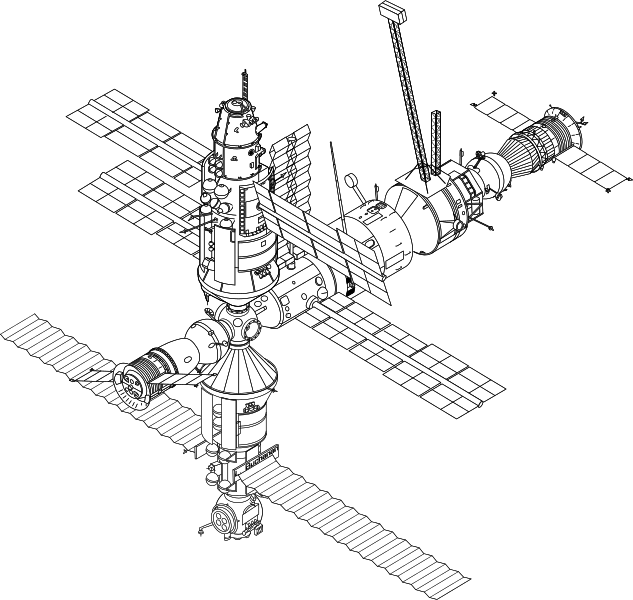
From Mercury to Voyager 1
Every body is positioned using data from JPL HORIZONS, NORAD TLEs, or published landing coordinates.
How Stargazer Works
Source
JPL HORIZONS for orbits. Celestrak for TLEs. wheretheiss.at for ISS. All public, all free.
Compute
Standish/Meeus for planets. Keplerian solver for moons. SGP4 for satellites. All client-side.
Render
Real axial tilts, real rotation, Saturn rings at correct radii. Compromises disclosed.
Verify
Every panel shows the real numbers. Cross-check against JPL, timeanddate.com, or Stellarium.
Free · Open source · No account required
Click anything in space
Fly to Voyager 1 in interstellar space, watch the Galilean moons orbit Jupiter, see Curiosity sitting in Gale crater. Free, open source, and runs in any modern browser.
Where we get the data
Not affiliated with NASA, ESA, JAXA, or SpaceX. We are fans building on public data.